You can write good content and still it may not be properly understood. This is exactly where the real problem arises.
Most websites focus on pages, keywords, and articles. Google, however, does not see pages in the same way as people. It creates a model of content using entities and relationships.
What does this mean in practice?
It means that your website is not evaluated as a list of pages, but as a network of meaning. If this network is unclear or incomplete, search performance becomes unstable.
How Google Knowledge Graph connects entities and builds context
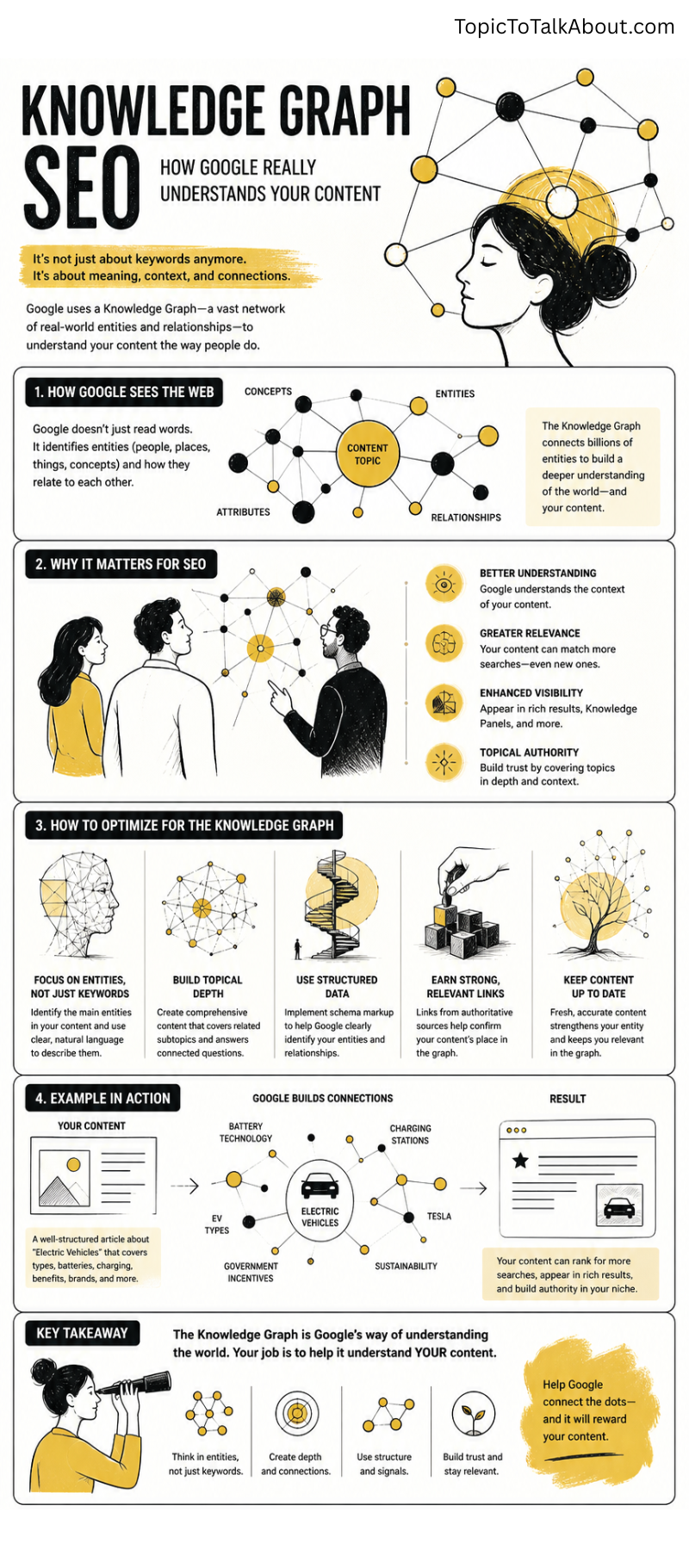
Google Knowledge Graph is a system that connects entities into a structured network. Each entity represents something clearly defined. It can be a person, a place, a concept, or a product.
Entities alone are not enough.
Google also needs relationships, which explain how entities are connected. Without relationships, context does not exist.
Let’s look at a simple example. If a page mentions VPN, encryption, and privacy, Google tries to understand how these concepts relate to each other. Are they explained together, do they support each other, or are they only listed without meaning?
These questions are answered by context.
That is why context is not an extra layer, but the core of understanding.
Why Google understands topics, not pages or keywords
Many people still think in terms of keywords. They create one page for each keyword and try to match search phrases as closely as possible.
Google does not work this way anymore.
It tries to understand topics.
A topic is not one keyword, but a group of connected entities. These entities create a structure. If your content covers only one part of a topic, it feels incomplete. If it connects multiple relevant parts, it becomes more trustworthy.
This is where many websites fail. They have content, but it does not form a coherent topic.
Why some pages feel clear and others feel incomplete
As a reader, you can often feel this intuitively. Some pages fully answer your question, while others leave gaps.
Why does this happen?
The reason is missing connections.
A page can contain the right entities, but still feel weak if relationships are not explained or important context is missing. For example, a page about VPN may list features but not explain their real-world use. Another page connects use cases, risks, and technical details, and therefore feels complete.
Search engines detect this difference. AI systems detect it even faster.
Entity disambiguation and why meaning depends on context
One word can have multiple meanings.
Think about the word Apple. It can mean a company or a fruit.
How does Google know the correct meaning?
Through context.
Entity disambiguation is a process where search engines determine what a word refers to. They analyze surrounding entities and relationships. If the content is clear, the correct meaning is obvious. If it is vague, interpretation becomes more difficult.
This has a direct impact on ranking.
Content that is easy to interpret is easier to place into the knowledge graph.
How AI systems read content through context window and fragments
AI systems do not read your entire website at once.
They work with smaller pieces of text, which are limited by what is called a context window. This significantly changes how content is processed.
Each part of your page should make sense on its own. It should contain clear entities and meaningful relationships. If a fragment is too vague, it loses value. If it is clear, it becomes usable.
This is one of the reasons why some pages appear in AI answers and others do not.
Why adding more pages does not always improve understanding
It is tempting to think that more content means better results.
Reality is different.
Quantity does not guarantee clarity. If new pages repeat the same ideas or introduce unrelated topics, they do not help. Instead, they create noise.
Understanding grows when new entities are added and properly connected. Without connections, real expansion does not happen.
Coverage gaps and information gain as signals of understanding
How can you recognize that your content is incomplete?
Look at what is missing.
Coverage gaps appear when important parts of a topic are not explained. These gaps reduce overall clarity.
Information gain works in the opposite direction. When a page adds something new and valuable, it helps complete the overall picture.
Search engines look for these signals. AI systems rely on them when combining information from multiple sources. A page that fills gaps is more valuable than one that only repeats known facts.
How relationships shape internal structure and internal linking
Internal links are often treated as a technical detail.
In reality, they reflect something deeper, the structure of your content.
If two pages are closely related, linking them is natural. If they are not, linking creates confusion. Good internal linking follows meaning and reflects relationships between entities.
This makes the website easier to navigate and also easier to understand.
Knowledge graph expansion as a way of thinking about content
Instead of seeing content as a list of pages, try to see it as a growing structure.
Each new page adds another piece. Each connection adds meaning.
Over time, the whole becomes more complete.
This is what knowledge graph expansion looks like in practice. It is not about volume, but about clarity and connection.
understanding comes from structure
If your content does not perform as expected, the problem is often hidden in its structure.
Google and AI systems try to understand how your content fits into a broader context. This picture is defined by entities, relationships, and context.
When these elements are clear, content is easier to process. When they are missing, even good content can struggle.
The goal is not to create more pages. The goal is to make meaning as easy to understand as possible.
Leave a Reply