
Let’s assume you want to become an expert in a completely new topic.
For example: mucin.
You may not know much about it yet. You might only have a vague idea that it relates to mucus or biology. That is a perfectly fine starting point.
The real question is: how do you move from basic awareness to structured knowledge that allows you to create high-quality content and eventually build topical authority?
Most people approach this in a fragmented way. They read a few articles, maybe check Wikipedia, open a couple of SEO tools, and start writing. The result is usually shallow coverage, repeated ideas, and content that does not connect well.
A topical map gives you a different starting point.
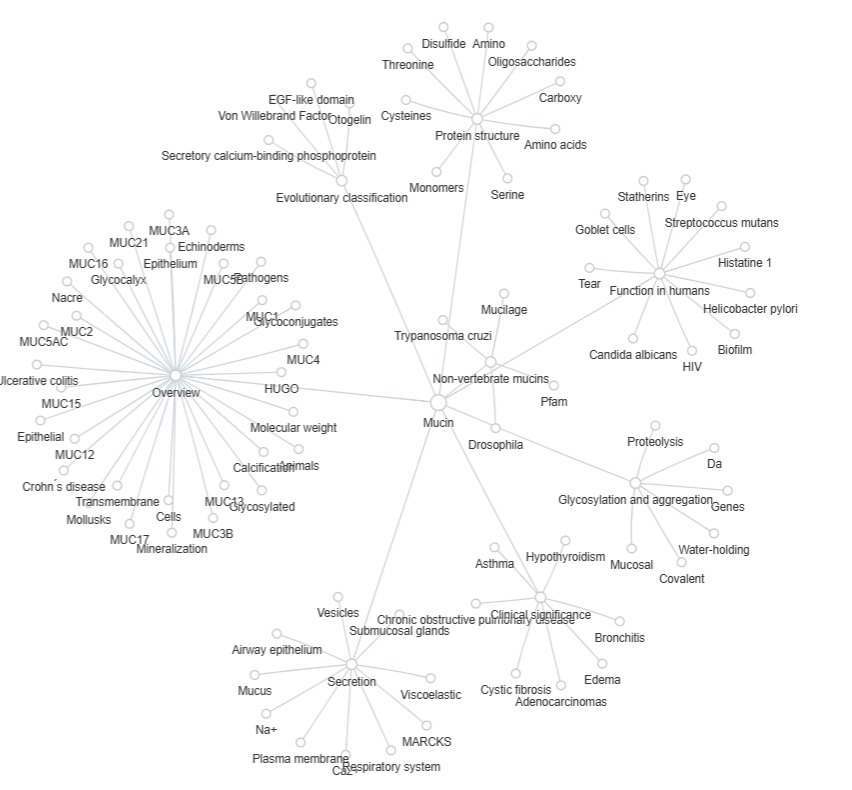
When you open the mucin page on Topicstotalkabout, you are not looking at a traditional article. You are looking at a structured representation of the topic — entities, relationships, clusters, and supporting data. At first, it may seem dense, but with the right approach, it becomes a very practical guide.
Understanding “Mucin” as an Entity, Not Just a Keyword
In traditional SEO, you might start with a keyword like “mucin” and look for related keywords.
In entity-based SEO, you treat mucin as a central concept connected to many other concepts.
From the map, you can see that mucin is linked to:
- glycoproteins, amino acids, protein structure
- mucus, epithelial cells, goblet cells
- diseases such as asthma, COPD, and Crohn’s disease
- gene families like MUC1, MUC2, MUC5B
- microorganisms such as Helicobacter pylori or Candida albicans
This tells you something important: mucin is not a narrow topic. It sits at the intersection of biology, medicine, and molecular processes.
If you want to build topical authority, you need to reflect this structure in your content. That means covering not only definitions, but also functions, mechanisms, variations, and real-world implications.
Step 1: Reading the Topical Map in a Practical Way
You do not need to understand every node or every relationship immediately.
Start by scanning for patterns:
- Which sections are clearly grouped?
- Which terms appear frequently?
- Which areas seem to have many connections?
On the mucin page, several natural clusters emerge:
- protein structure and composition
- function in humans
- clinical significance (diseases)
- secretion mechanisms
- gene families (MUC genes)
These clusters are your foundation. You can think of them as the main “chapters” of the topic.
At this stage, you are not writing yet. You are building a mental outline.
Step 2: Turning Clusters into a Content Structure
Each cluster can be developed into a group of articles.
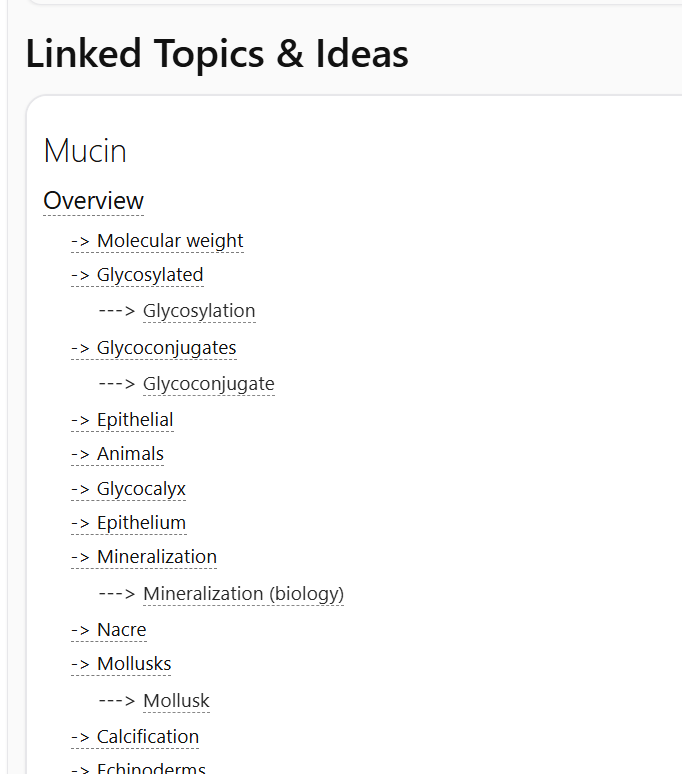
For example, the protein structure cluster includes terms such as glycosylation, amino acids, and molecular properties. From this, you can create content like:
- What mucin is made of
- How glycosylation influences mucin properties
- Why mucins form gel-like structures
The function cluster leads to topics such as:
- The role of mucin in protecting epithelial surfaces
- How mucin contributes to hydration and barrier function
- The role of mucin in mucus formation
The clinical cluster naturally expands into:
- Mucin and respiratory diseases such as asthma or COPD
- Mucin in gastrointestinal conditions like Crohn’s disease
- The impact of mucin imbalance in chronic inflammation
The gene cluster gives you another layer:
- What MUC genes are
- Differences between MUC1, MUC2, and MUC5B
- How gene expression affects mucin production
And the pathogen-related entities open further directions:
- How mucin interacts with bacteria
- The role of mucin in defending against infections
- Specific interactions with organisms like Helicobacter pylori
By following the clusters, you gradually build a structured content plan without guessing what to write next.
Step 3: Using Relationships to Go Deeper
One of the most useful parts of Topicstotalkabout is the relationships between entities.
Instead of only listing topics, the map shows how they connect.
For example:
- mucin is related to secretion
- mucin is related to pathogens
- mucin is related to protein structure
Each of these relationships can guide a specific type of article.
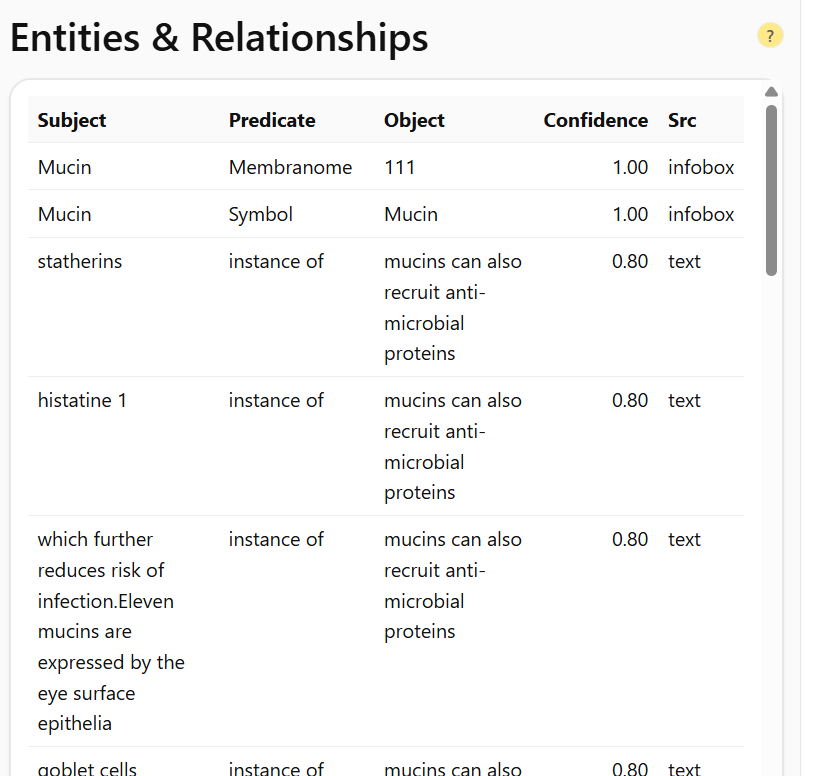
Rather than writing a general overview, you can focus on a single connection:
- how mucin is secreted, including the role of vesicles and calcium
- how mucin interacts with pathogens and contributes to immune defense
- how structural properties influence mucin’s biological function
This approach naturally leads to more detailed and useful content. It also helps avoid repetition, because each article explores a different aspect of the same entity.
Step 4: Building Internal Linking Based on Topic Structure
As your content grows, internal linking becomes very important.
Instead of linking randomly, you can follow the same structure you saw in the topical map.
For example:
- a main page about mucin links to pages about structure, function, and diseases
- the diseases page links to specific conditions such as asthma or COPD
- the pathogens page links to individual microorganisms
This creates a network of pages that mirrors the relationships between entities.
From a user perspective, this makes navigation easier. From a search engine perspective, it reinforces the idea that your site covers the topic in a coherent and comprehensive way.
Step 5: Using Word and Phrase Data for Content Coverage
The word statistics and phrase data on the page are not just technical details.
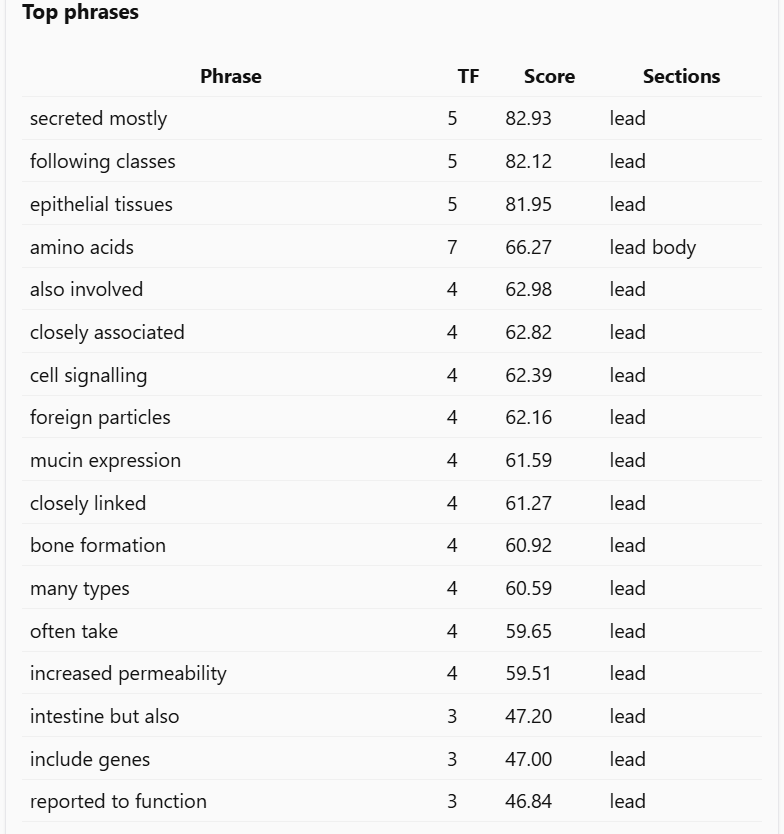
They show how the topic is typically described.
If certain terms appear frequently — such as “mucus”, “cells”, “proteins”, or “airway epithelium” — they are likely important for understanding the topic.
You do not need to force these terms into your text. Instead, use them naturally when they fit the explanation.
This helps ensure that your content aligns with how the topic is actually discussed in reliable sources.
Step 6: Applying the Same Method to Other Topics
Once you understand how to work with mucin, the same process applies to any other topic.
For each new topic:
- open the topical map
- identify the main clusters
- examine key relationships
- create a layered content plan
- connect articles through internal links
Over time, this becomes a repeatable workflow.
The topic may change, but the way you approach it remains consistent.
Step 7: Keeping Your Content Unique Across a Series
If you plan to create many articles using this method, it is important to avoid making them all look the same.
You can vary your approach by:
- focusing on different types of clusters depending on the topic
- starting from a different angle (definition, problem, use case)
- emphasizing different relationships
- adjusting the depth of explanation
For mucin, the focus naturally leans toward biology and health.
For another topic, the emphasis might be on technology, business models, or user behavior.
This variation keeps the content useful and avoids duplication, even though the underlying method is similar.
A Practical Way to Start
If you want to build topical authority for mucin, you can begin with a simple structure:
- one main page explaining mucin as a concept
- several pages covering the main clusters (structure, function, diseases, genes)
- a set of more specific articles focusing on individual relationships or entities
As you expand, you can return to the map to identify areas that are not yet covered.
This approach gives you direction at every step. You are not guessing what to write next; you are following a structured representation of the topic.
Closing Perspective
Working with topical maps changes how you learn and how you create content.
Instead of collecting isolated pieces of information, you build a connected understanding of a subject.
Over time, this makes it easier to write clearly, cover topics more completely, and organize content in a way that reflects how knowledge is actually structured.
For someone starting from scratch, this can significantly shorten the path from beginner to confident practitioner.
Leave a Reply