
When we talk about entities, we often imagine big ones, companies, countries, famous people, products.
But the web doesn’t think only in capitals. It learns through small details, the micro-entities that live inside your paragraphs: event names, model numbers, local places, even nicknames or slang.
These fragments may look trivial, but they are the semantic fingerprints that tell search engines and readers what your content truly knows.
What Are Micro-Entities and Why They Matter

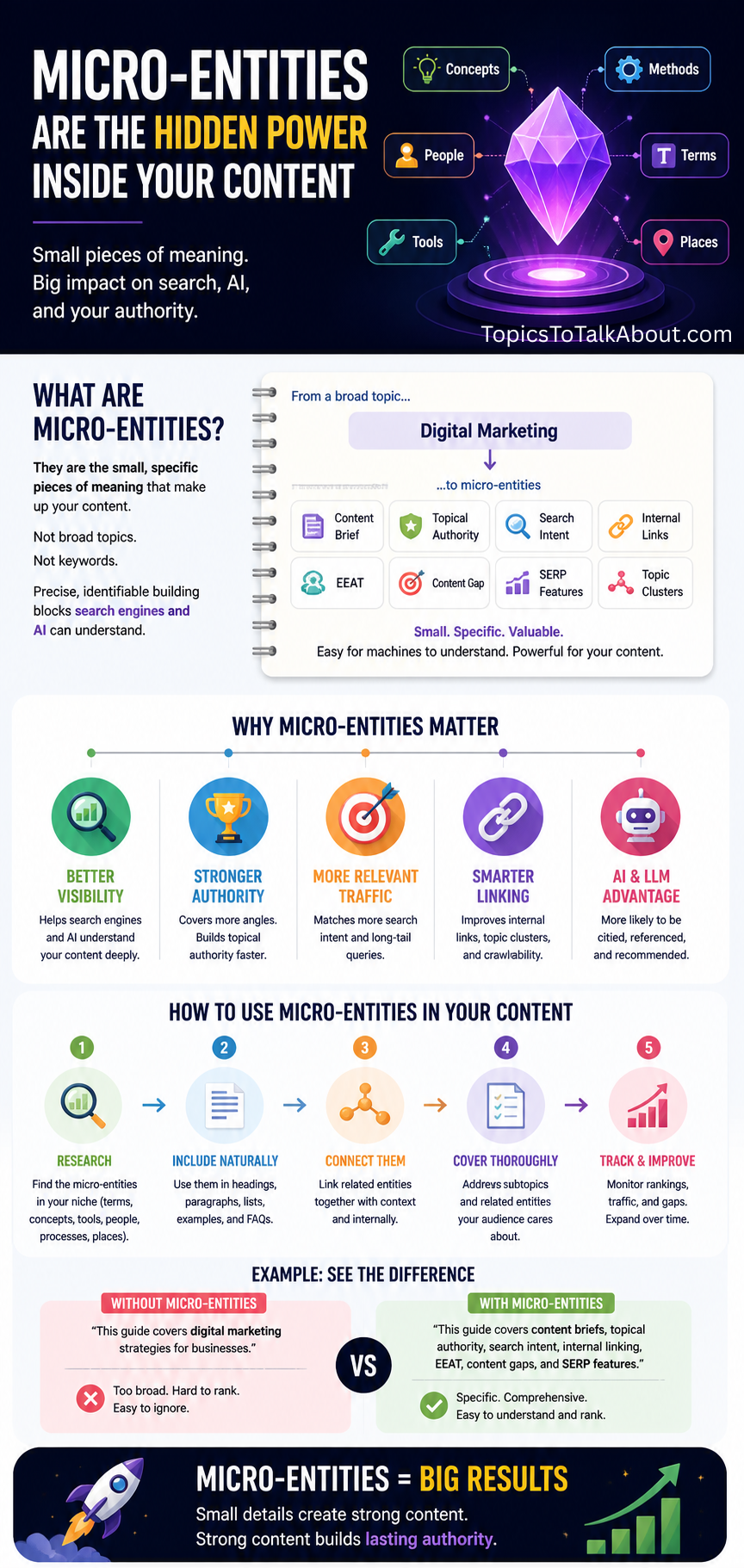
Micro-entities are small, specific references that connect your text to the long tail of knowledge.
Think of them as the atoms of meaning. A “conference,” a “street,” a “version,” or a “character name”, they form contextual bridges between general topics and specific knowledge.
A simple example:
“Tesla introduced a new autopilot update in version 12.4.1 during the Berlin rollout.”
In that one sentence, you can find at least five entities:
- Tesla – organization
- Autopilot – product feature
- 12.4.1 – version entity
- Berlin – location
- rollout – event-type action
Each one adds precision. Together they form a semantic cluster that defines what kind of information this sentence carries.
How Micro-Entities Strengthen Context and Relevance
Search engines no longer index strings, they index things.
By mentioning micro-entities, you make your content denser in meaning, easier to connect to knowledge graphs, and more likely to appear in entity-based search results.
Here’s what happens under the hood:
- Context anchoring: Each micro-entity locks your paragraph to a known concept in the web’s knowledge graph.
- Semantic triangulation: When two micro-entities co-occur, algorithms infer a relationship (Tesla ↔ Berlin ↔ rollout).
- Topical precision: The more fine-grained your entities, the less your content competes in vague keyword spaces.
This is why a detailed product review or a technical blog often outranks broad, generic guides, it’s semantically rich.
Finding and Mapping Micro-Entities
You don’t need to mark them manually with schema (although you can). You only need to recognize and use them consciously.
A few ways to surface micro-entities in your own text:
- Look for specific nouns and proper names. People, tools, models, datasets, conferences, standards.
- Mine your paragraphs. Each line usually hides one entity you didn’t think about.
- Use entity extraction tools. TTTA’s own semantic parser can visualize hidden entities and show how they connect.
- Compare similar articles. If two texts about the same topic mention different entities, they occupy different semantic territories.
Once you start tracking them, you can build what TTTA calls a micro-entity map, a visual of your content’s inner architecture.
Micro-Entities and the Semantic Gap
Most “semantic gaps” in content happen not because of missing keywords, but because of missing entities.
Two texts might cover the same subject, but one includes the precise event names, datasets, or tools, and that’s what makes it contextually complete.
If you write about “image classification,” but never mention ImageNet, ResNet, or PyTorch, you’re leaving an empty space in the graph.
Your content exists, but it’s floating without links.
Filling that micro-layer is how you close the semantic gap.
Micro-Entities in Topic Planning
When you build a topical map, micro-entities help you:
- detect hidden subtopics,
- plan internal linking between related pages,
- and identify knowledge gaps that generic keyword research misses.
Example: if your central topic is “renewable energy,” micro-entities could include “NREL,” “PVWatts,” “Feed-in Tariff,” “Intersolar Europe.”
Each one opens a micro-topic, something people actually search for, but rarely cluster correctly.
That’s where topicstotalkabout can surface fresh talking points or content ideas, not from keywords, but from entity relationships.
When Micro Becomes Macro
Small details scale.
Once your content consistently uses rich micro-entities, the whole website gains stronger semantic coherence.
It starts to behave like an organized mind, connecting projects, places, and ideas through shared entities.
This is what large language models already do internally. By making your entity layer explicit, you’re simply joining the same game, but on your own terms.
The Hidden Power of Small Things
Big ideas make readers curious.
Small entities make algorithms understand.
If you want your content to mean more, not just rank higher, look inside the sentences.
That’s where the real intelligence lives: in the micro.
Leave a Reply