
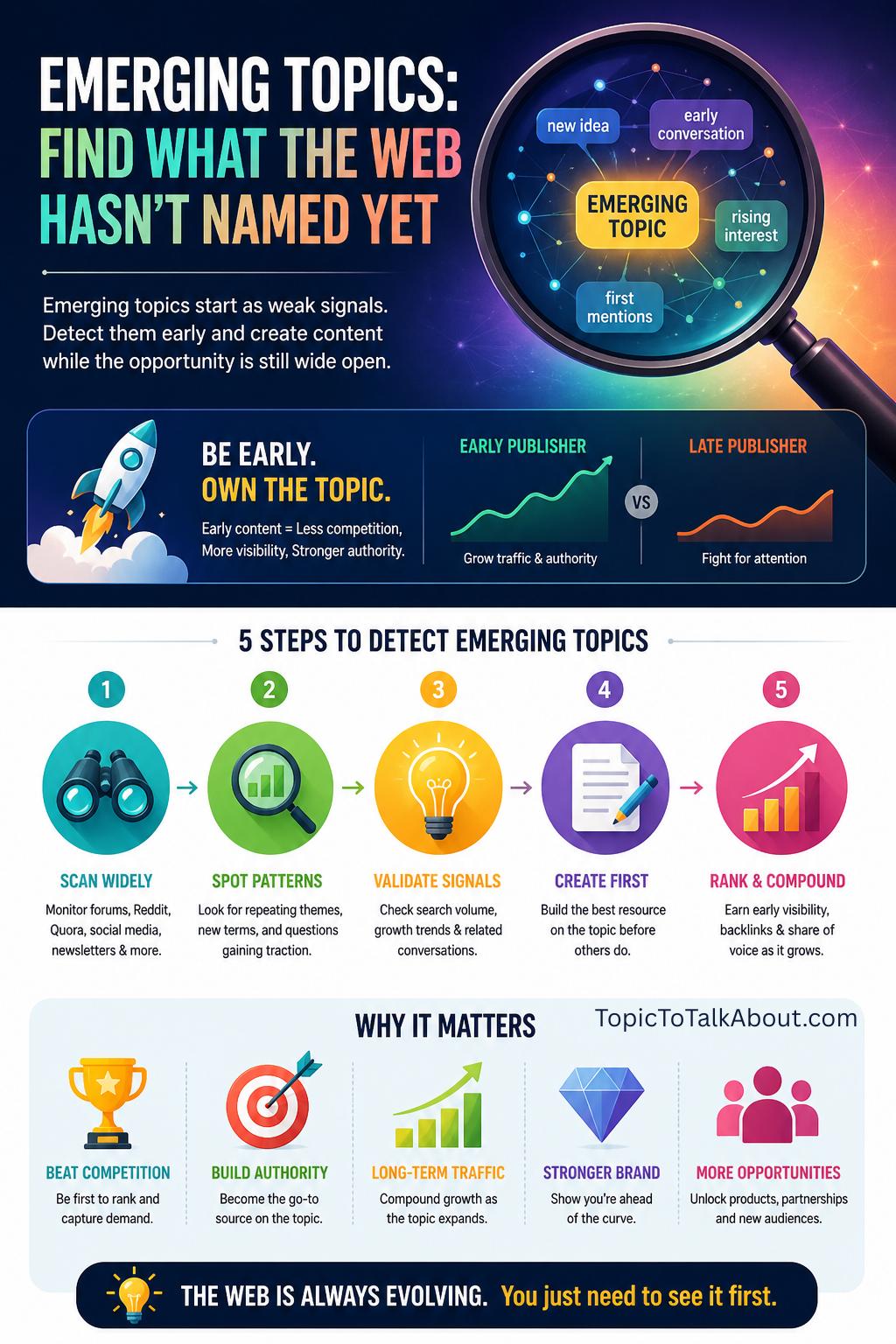
Emerging topics exist even before people give them a name.
Before a topic becomes visible, it already lives in language. It appears as small signals, weak connections between ideas, which are used only by early individuals. Every big trend, whether blockchain or AI ethics, started exactly like this.
The ability to notice these signals early belongs today among the most important skills in SEO and content strategy. If you learn this, you stop only reacting to search trends and you start predicting them.

What are emerging topics in SEO and semantic search
Emerging topics in SEO are new topics that are still forming and do not have fixed boundaries.
They are groups of ideas, entities and relationships, which begin to appear together, but still do not have one stable name. At the beginning they feel unclear, different people use different words and the meaning is not fully clear.
From the point of view of semantic SEO, these are emerging entities and entity relationships, which are gradually finding their place in the knowledge graph.
Over time these connections become stronger and at the moment when a name stabilizes, the topic becomes visible also in search.
Why emerging topics matter for SEO and content strategy
Emerging topics matter because they give you an advantage before competition appears. While traditional SEO reacts to existing keywords and search trends, emerging topics allow you to create content even before these keywords exist.
When you publish early, something important happens. Your content becomes one of the first explanations of the topic. In practice, this means first mover advantage, which later transforms into topical authority.
Others begin to use similar language, search engines connect your content with the new idea and gradually start to treat it as a reference point. You are not adapting to a trend, you create it or shape it.
Where emerging topics come from
Emerging topics most often come from the intersection of different fields, when their languages and approaches start to mix.
When two or more disciplines begin to influence each other, new concepts and meanings are created. This process is often called topic discovery or the creation of new content trends.
For example, the connection of artificial intelligence and journalism created “synthetic media”, the combination of engineering and data science created “digital twin”, and the connection of neuroscience with design created “neuroarchitecture”.
At the beginning these terms do not have a precise definition, but they already exist in discussion. And that is the moment when an emerging topic is born.
How to detect emerging topics using semantic signals
Detecting emerging topics is mainly about observing changes in language and how new ideas start to connect.
If you notice that new combinations of topics appear repeatedly, new phrases are created or some terms grow quickly even if they are still rare, these are strong semantic signals.
From the point of view of NLP (natural language processing), these are changes in entity co-occurrence and in how relationships between concepts evolve.
Simply said, if something feels new, but at the same time starts to appear repeatedly in different contexts, you are probably observing the creation of a new topic.
From chaos to clear meaning in emerging topics
Emerging topics always go through a phase of chaos before they stabilize and begin to dominate as new trends in search.
At the beginning there are multiple names, different interpretations and unclear boundaries. Different people describe the same thing in different ways, which creates confusion. Gradually one term starts to dominate, the meaning stabilizes and the topic begins to appear also as a clear search trend or keyword cluster. That is the moment when an emerging topic becomes a stable SEO topic.
Entity drift and emerging topics in SEO
Emerging topics are closely connected with the concept of entity drift in SEO, which describes how the meaning of existing concepts changes.
Entity drift means that known concepts gradually evolve and shift inside the knowledge graph. When this change is strong enough, a new topic appears.
It can be said that the original concept splits and creates a new semantic space.
If your content stays tied to the old meaning, it gradually loses relevance. If you adapt, you naturally move into the new semantic space.
How to use emerging topics in content strategy
Using emerging topics in content strategy means writing about topics at a time when they are not yet fully defined. This is not easy but you do not need to know everything exactly. What matters is to be early and stay flexible. This is the foundation of modern content planning and SEO strategy.
Write in a way that explores the topic. Leave space for multiple meanings and update your content as the topic evolves.
This is how you build both your content, and also long-term topical authority.
Topical maps and detecting emerging topics
Topical maps are a very strong tool for detecting emerging topics before they appear as full search trends.
When you observe entity relationships and connections between topics, you start to notice small clusters forming at the edges of the map. These clusters gradually grow and connect further. In data, you can see this as increasing connection density. If some connections become stronger faster than others, it is a clear signal that we havean emerging topic.
Why emerging topics give longterm SEO advantage
Emerging topics give you long-term advantage mainly because you enter the topic early.
When you are among the first, your content becomes part of how the topic is defined in search engines and in the knowledge graph.Over time more content appears, but yours keeps its importance because it was there at the beginning. This is how real topical authority and long-term visibility in search are built.
These topics already exist, we just do not see them clearly yet
Emerging topics already exist, they just do not yet have a clear name and do not appear as standard search trends.
However, they are present in discussions, in small semantic signals and in new combinations of ideas.
If we learn to notice them, we can stop reacting to content. An we can start actively doing trend detection and understanding where the web is moving.
Leave a Reply