
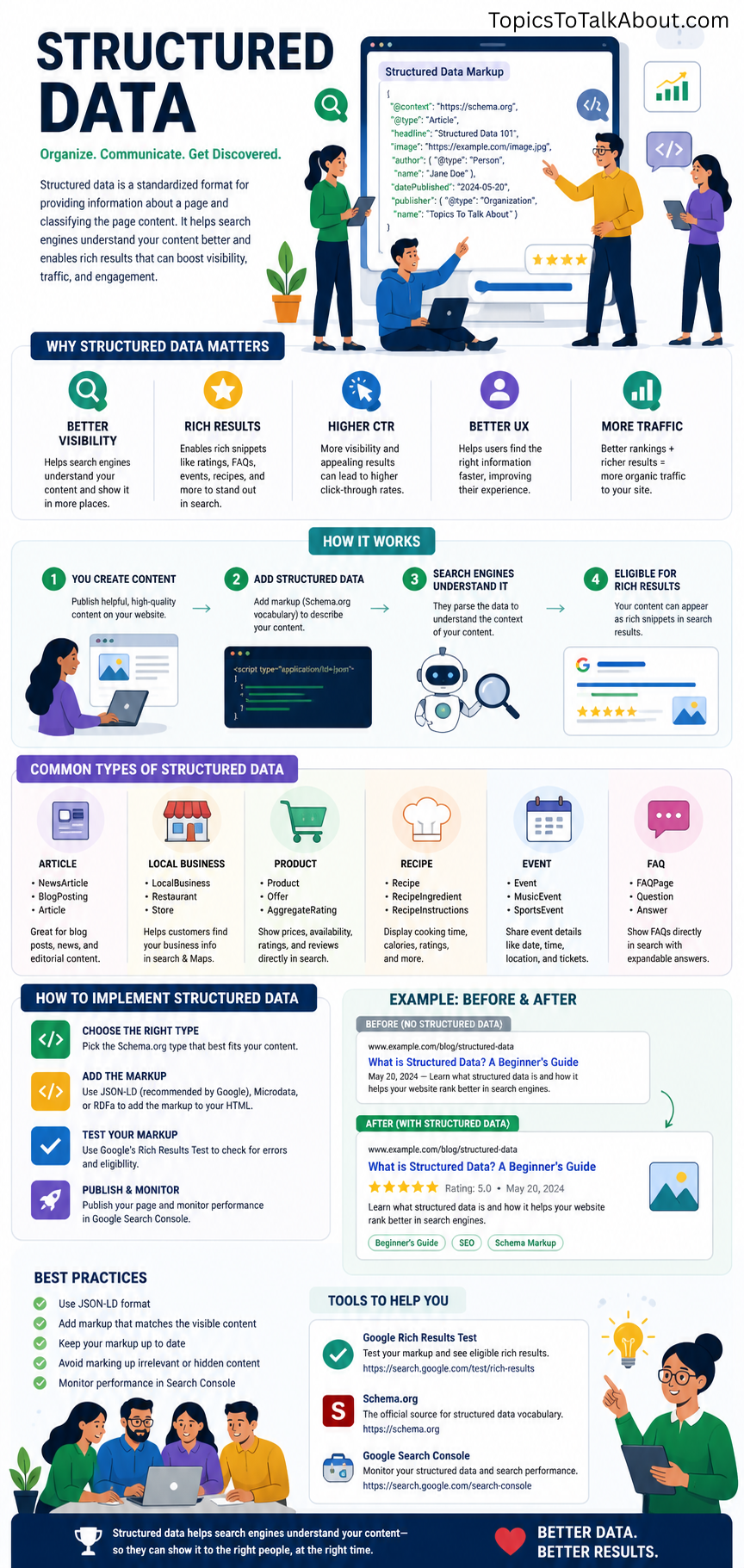
Structured data in SEO helps search engines understand your content, not only read it.
You can write a perfect paragraph and still confuse the web. It is because search engines do not read sentences like people, but they read structure.
Structured data tells the machine what your words really mean. Not only “this is text”, but “this is a person”, “this is an event” or “this is a product rating”.
And this small difference, between text and meaning, changes how your content is seen, indexed, and connected.

Why structured data matters for entities and SEO
Structured data in SEO matters because search engines work with entities, not only with keywords.
Search engines no longer rely only on keywords. They work with entities, which are real concepts like people, companies, products or topics.
Structured data is a bridge between what you write and how algorithms understand it. When you use schema markup (for example Schema.org), you give your content a clear meaning inside the knowledge graph.
Simply said, structured data tells Google: “I know exactly what this page is about.”
How structured data works (simple explanation)
Structured data works in a way that you add additional information to your page using markup, for example JSON-LD.
Structured data uses markup, most often JSON-LD, to describe meaning directly in HTML. For example, in an article you can define its title, author or publication date.
{
  "@context": "https://schema.org",
  "@type": "Article",
  "headline": "Micro-Entities: the Hidden Power Inside Your Content",
  "author": {
    "@type": "Person",
    "name": "Kaudo"
  },
  "datePublished": "2025-10-13"
}
For a human it looks technical.
For a search engine it is clear meaning.
Structured data and the semantic web (simple context)
Structured data comes from the idea of the semantic web, which means a web that machines can understand.
The idea of structured data was created even before SEO. It comes from the semantic web, which was proposed by Tim Berners-Lee.
The goal was simple: to create a web that is not only readable, but also understandable.
When you use schema markup, you help to build this system. You are not only optimizing a page, but you are participating in a bigger network of knowledge.
Types of structured data in SEO (with examples)
There are more types of structured data in SEO and each type describes a different kind of content.
For example, an article has an author and a date. A product has a price and rating. An event has time and location.
You do not need to remember lists. It is enough to imagine that each type of page has its own identity.
Structured data defines this identity clearly.
Structured data and micro-entities in content
Structured data defines the main topic, but micro-entities complete the details.
Structured data tells search engines what the page is about as a whole. But inside the text there are smaller elements, like names of tools, brands, people or datasets.
These are micro-entities.
When structured data and micro-entities work together, the content is much more understandable. One layer defines structure, the other completes meaning.
How to use structured data without breaking content
Structured data should support content, not complicate it.
Start by clarifying what your page is. An article, a product or an event. Then choose the correct schema type.
Use JSON-LD, because it is simple and recommended by Google.
Always check if structured data works correctly. And most important, it should be consistent with the content.
Structured data should confirm what you write, not say something different.
Structured data is not only SEO code
Structured data is not only technical code, but a way how to explain meaning.
Many people see it only as an addition for stars or FAQ boxes. But that is only a small part.
Structured data is like grammar for machines. It helps them understand content the same way grammar helps people understand text.
When you look at it this way, it stops being “just code”.
Why structured data is the language of the web
Structured data is the language of the web because it describes relationships between things.
The web does not understand style or emotion. But it understands relationships.
Structured data allows you to describe these relationships clearly and precisely.
And when you connect it with micro-entities and a strong topic, your content becomes part of a bigger system.
Leave a Reply