
Let’s assume you want to understand and cover a topic like James Tolkan.
You might know him as the strict school authority figure from Back to the Future. Or you may have seen him in Top Gun or other films without remembering his name.
That is a very common starting point.
Now imagine you want to build a website or a set of articles that makes you feel confident about this topic. Not just one page, but a small knowledge base that covers James Tolkan properly.
The question becomes:
Where do you start, and how do you know what is missing?
Looking at James Tolkan Through a Topical Map
When you open the page for James Tolkan on Topicstotalkabout, you are not reading a biography.
You are looking at a structured overview of the topic.
You can see several clearly separated areas:
- Overview
- Career
- Early life
- Filmography
And around them, many connected entities:
- films like Back to the Future, Top Gun, WarGames
- TV series like Miami Vice or The Fresh Prince of Bel-Air
- people such as Sidney Lumet or Woody Allen
- places like Calumet, Michigan or Saranac Lake, New York
If you take a moment to look at this structure, you start to understand what the topic actually contains.
It is not just a person with a date of birth and a list of films.
It is a combination of:
- personal background
- professional work
- specific roles
- connections to other films and creators
This is the foundation you will build on.
Step 1: Start by Understanding the Main Areas of the Topic
Before writing anything, it helps to divide the topic into a few clear parts.
From the map, you can identify:
- who James Tolkan is (overview)
- where he comes from (early life)
- what he has done (career)
- where exactly he appeared (filmography)
This may sound simple, but it is important.
Many people skip this step and start writing immediately. That often leads to incomplete or unbalanced content.
Here, you already have a guide.
Step 2: Create a Simple and Clear Overview
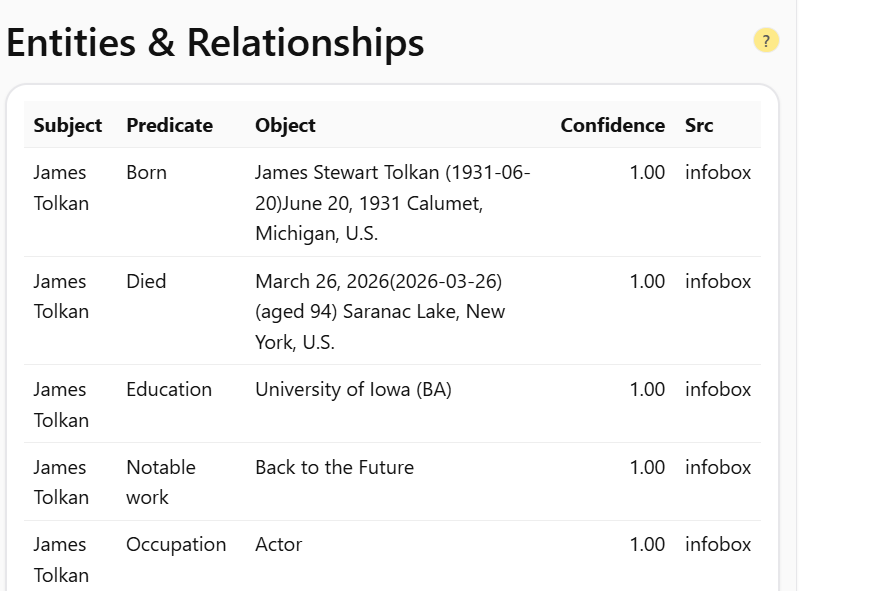
The overview page should answer basic questions in a natural way:
- Who is James Tolkan?
- What kind of actor is he?
- What is he best known for?
For example, you can explain that he is a character actor who often played strict or authoritative roles, and that many people remember him from Back to the Future.
At this point, you do not need to go into detail about every film.
The goal is to give the reader orientation.
Once someone reads this page, they should understand why the name matters.
Step 3: Spend Most of Your Time on the Career Section
When you look at the map, the Career cluster is the largest.
This is a useful signal.
It means that most of the meaningful information about James Tolkan is connected to his work.
Instead of writing one long paragraph about his career, it helps to break it into smaller, understandable parts.
Film Roles and Recognizable Appearances
You can start with well-known films:
- Back to the Future
- Top Gun
- WarGames
- Serpico
- Prince of the City
For each of these, you can explain:
- what role he played
- what kind of character it was
- why people remember it
You may notice a pattern. He often plays authority figures, officials, or strict personalities. Describing this pattern helps readers understand his acting style.
Television Appearances
The map also shows many TV series:
- Miami Vice
- The Fresh Prince of Bel-Air
- Remington Steele
- A Nero Wolfe Mystery
This gives you another layer.
You can explain:
- how often he appeared on television
- the types of roles he played there
- how TV work differs from film work in his career
This helps fill in gaps that a simple film list would miss.
Explaining the Idea of a “Character Actor”
The term “character actor” appears in the overview.
For someone new to the topic, this may not be obvious.
It helps to explain it in simple terms:
A character actor is someone who often plays supporting roles, but in a very distinctive way. These actors are recognizable, even if they are not always the main star.
You can then show how James Tolkan fits this description through his roles.
This adds understanding, not just information.
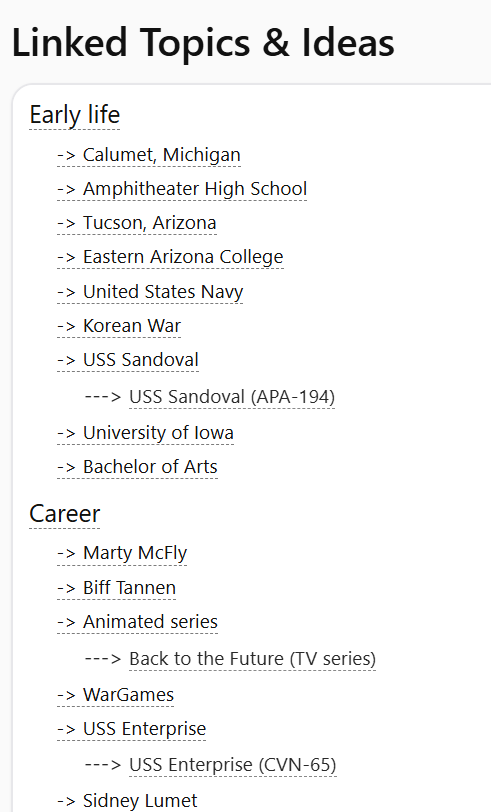
Step 4: Add Context Through Early Life
The Early life cluster gives you:
- Calumet, Michigan
- Tucson, Arizona
- University of Iowa
- United States Navy
- Korean War
This part helps answer a different kind of question:
Where did he come from?
You can describe:
- his education
- his military service
- how he eventually moved into acting
Even if this section is shorter, it gives the topic balance.
Without it, the content would feel incomplete.
Step 5: Use Filmography as a Structured Reference
The filmography is useful, but it should not dominate the content.
Instead of listing everything in one place without context, you can:
- highlight key films in your main content
- keep a structured list for reference
- link between the list and detailed explanations
This makes the content easier to navigate.
Some readers want a quick overview, others want detail. This approach supports both.
Step 6: Let Relationships Guide Your Next Articles
The topical map shows relationships such as:
- James Tolkan → Back to the Future
- James Tolkan → Top Gun
- James Tolkan → University of Iowa
- James Tolkan → Sidney Lumet
Each of these connections can become a separate piece of content.
For example:
- a deeper look at his role in Back to the Future
- an article about his collaboration with certain directors
- a page about his education and how it influenced his career
You do not need to invent topics. You can follow the connections that already exist.
Step 7: Use Common Terms Naturally in Your Writing
The word data shows how people usually describe him:
- “best known”
- “character actor”
- “high school vice-principal”
- “film roles”
When you write naturally about his work, these phrases will appear on their own.
For example, when you describe his role in Back to the Future, it is natural to mention that he is best known for playing a strict school authority figure.
This helps your content feel natural and complete.
Step 8: Connect Your Pages in a Logical Way
As you create more content, linking becomes important.
You can structure it simply:
- the main page links to career, early life, and filmography
- the career page links to individual films and series
- those pages link back to the main topic
This creates a clear path for readers.
It also helps search engines understand how your content is organized.
Step 9: Keep Expanding Step by Step
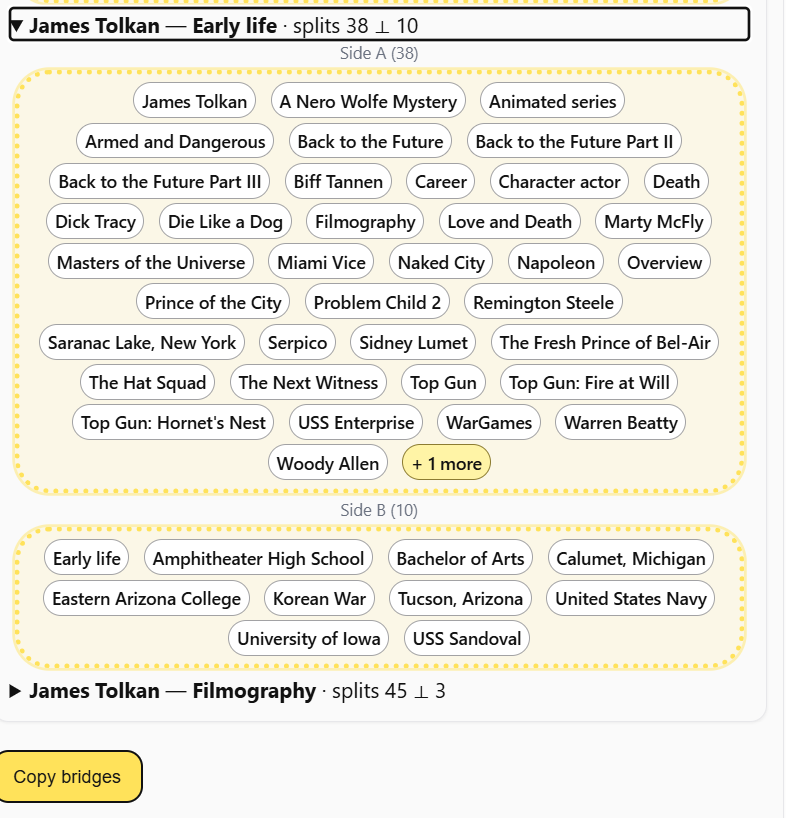
Once the main parts are covered, you can return to the map.
Look for:
- films you have not described yet
- TV appearances you skipped
- related people (directors, actors)
For example:
- Sidney Lumet
- Woody Allen
- Warren Beatty
Each of these can lead to additional content if you want to go deeper.
A Practical Way to Begin
You do not need to build everything at once.
You can start with:
- one overview page
- one career page
- one early life page
- one page focused on key roles
Then gradually expand:
- add more films
- add TV roles
- connect everything together
Move In a Clear Direction
Working with a topical map helps you move in a clear direction.
Instead of guessing what to write next, you can look at the structure and see what is already covered and what is missing.
Over time, this leads to content that feels complete and connected.
For a topic like James Tolkan, this means you are not only presenting facts, but also building a clear picture of the person, their work, and their place in film and television.
Leave a Reply